In the world of culinary arts, few techniques have generated as much buzz and transformative potential as sous vide cooking. At its heart, sous vide—French for "under vacuum"—involves sealing food in airtight bags and immersing it in a precisely temperature-controlled water bath. While the method itself isn't new, having been used in professional kitchens for decades, it is the recent accessibility of precise and affordable immersion circulators for home cooks that has truly democratized this technology. The core promise of sous vide, and arguably its most revolutionary aspect, is its unparalleled precision, often boasting tolerances within ±0.5°C. This microscopic margin of error is not just a technical specification; it is the key that has unlocked a new paradigm for cooking the steak, fundamentally challenging and redefining our very understanding of doneness.
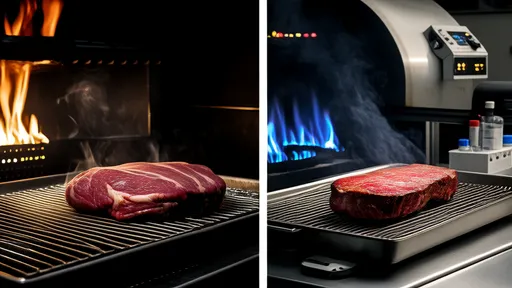
For centuries, the art of cooking a steak was a high-stakes dance with fire. A chef's skill was measured by their ability to judge heat, time, and the idiosyncrasies of a specific cut of meat, all while battling the relentless and uneven nature of direct heat. The goal was to achieve a perfect internal temperature—a juicy, pink medium-rare, for instance—while simultaneously creating a flavorful, caramelized crust. This process was inherently flawed. The intense heat necessary for the Maillard reaction on the outside would inevitably create a gradient of doneness, a "bullseye" effect where the interior would be perfectly cooked, surrounded by rings of increasingly overcooked meat. The difference between a perfect medium-rare and a disappointing medium could be a matter of mere seconds or a few degrees, a window so small it was often missed, leaving the fate of an expensive cut to chance and guesswork.
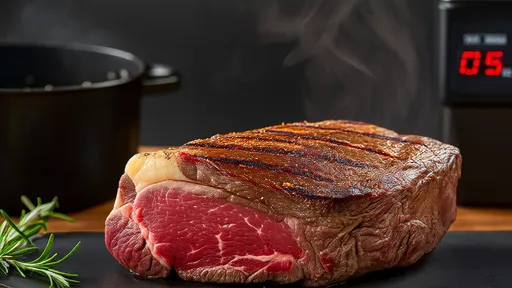
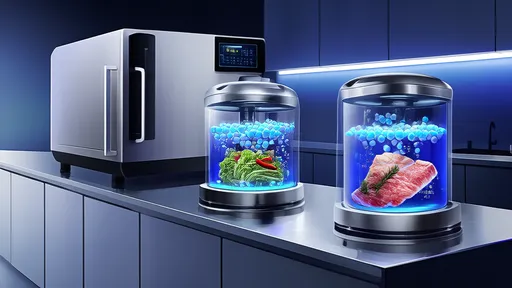
The introduction of the ±0.5°C precision of sous vide technology dismantles this entire volatile system. It separates the two fundamental objectives of cooking a steak—achieving the exact internal doneness and developing the crust—into two distinct, controlled phases. In the first and most critical phase, the steak is vacuum-sealed and placed in the water bath set to the exact target temperature of the desired doneness. For a perfect medium-rare, that is 55°C (131°F). The immersion circulator then holds the entire mass of the meat at that temperature for an extended period, often one to four hours. This is where the magic happens. Because the water bath cannot exceed the set temperature, the steak is physically incapable of overcooking. It will reach 55°C throughout and stay there. The result is a piece of meat that is perfectly, uniformly, and consistently cooked from edge to edge. There is no gradient, no gray band of overdone meat; just a wall-to-wall perfect pink that was previously impossible to achieve through traditional means.
This precision allows for a redefinition of doneness itself. Traditionally, doneness categories like rare, medium-rare, and medium were broad ranges because consistency was unattainable. With sous vide, they can be treated as exact temperatures. A cook can now decide they want their steak at 54°C for a slightly more tender rare or 57°C for a firmer medium-rare, knowing the result will be reproducible every single time. This control extends to dealing with the unique properties of different cuts. A tough, collagen-rich cut like chuck steak can be transformed by holding it at a medium-rare temperature of 55°C for 24 or even 48 hours. The gentle, prolonged heat breaks down the tough connective tissues into unctuous gelatin without ever causing the muscle fibers to seize and expel their moisture. The result is a steak that has the buttery texture of a prime filet but the deep, beefy flavor of a traditionally tough cut—a culinary alchemy that borders on the miraculous.
Of course, a steak cooked solely in a water bath is perfectly cooked but pale and unappealing. This is where the second phase comes in: the sear. After its long, precise bath, the steak is removed, patted extremely dry, and then subjected to the most intense blast of heat possible—whether in a scorching cast-iron skillet, with a culinary torch, or on a blazing-hot grill. This step is now performed without any fear or anxiety. The interior is already perfectly cooked and stable. The cook can focus solely on creating a deep, dark, crispy crust in 60 to 90 seconds per side, knowing they are merely adding flavor and texture, not trying to nail an internal temperature against the clock. The sear becomes a finishing touch rather than the main event.
The implications of this technological shift are profound. It has demystified what was once considered the pinnacle of home cooking. Novice cooks can now produce steakhouse-quality results with a level of consistency that would make a seasoned chef envious. It allows for unparalleled convenience and flexibility; steaks can be cooked ahead of time and held at their perfect temperature for hours before being quickly seared to serve guests. Most importantly, it has shifted the focus from a cook's intuitive, hard-won experience to one of scientific certainty. The question is no longer "How do I cook this perfectly?" but "What perfect temperature do I want to achieve?" This precision has not just improved how we cook steak; it has fundamentally changed the conversation around it, turning an art fraught with uncertainty into a precise and repeatable science, all held together by the remarkable guarantee of ±0.5°C.
By /Aug 29, 2025
By /Aug 29, 2025
By /Aug 29, 2025
By /Aug 29, 2025

By /Aug 29, 2025

By /Aug 29, 2025
By /Aug 29, 2025
By /Aug 29, 2025
By /Aug 29, 2025
By /Aug 29, 2025
By /Aug 29, 2025

By /Aug 29, 2025
By /Aug 29, 2025
By /Aug 29, 2025
By /Aug 29, 2025
By /Aug 29, 2025
By /Aug 29, 2025
By /Aug 29, 2025

By /Aug 29, 2025
By /Aug 29, 2025