In the quiet hum of a home kitchen, where flour drifts like snow and sugar sparkles under the lights, a silent battle has been waged for generations. It is a conflict between two methods of measurement: the comforting scoop-and-sweep of volume and the clinical precision of weight. For the casual cook, a cup is a cup. But for the baker, that same cup can be the difference between a soaring, buttery croissant and a dense, disappointing brick. The heart of the matter lies not in the ingredients themselves, but in how we choose to quantify them.
The practice of using volume measurements—cups, tablespoons, and teaspoons—is deeply ingrained, particularly in American culinary tradition. Our grandmothers’ recipes, scrawled on faded index cards, are testaments to this system. They speak a language of heaping cups and rounded teaspoons, a language of intuition and feel. There is a undeniable romance to it, a connection to a time when kitchens were not filled with digital gadgets but with seasoned hands that knew the dough was ready by its springback. This method is accessible; almost every household possesses a set of measuring cups. It feels straightforward, almost foolproof. You fill the cup, you level it off, and you proceed. What could possibly go wrong?
The answer, as any serious pastry chef will tell you, is almost everything. The fundamental flaw of volume measurement is its shocking inconsistency. It is a system built not on immutable constants, but on variables that change from baker to baker, from kitchen to kitchen, and even from moment to moment. Consider a cup of all-purpose flour. If you were to take that same cup and scoop it directly from the bag, you might pack in 150 grams of flour. But if you were to spoon that flour gently into the cup and level it off without tapping, you might only have 120 grams. That’s a 30-gram discrepancy—nearly a quarter of the total amount—in a single cup, based purely on the method of filling. This is not a minor margin of error; it is a chasm.
This variability extends to the ingredients themselves. Flour is notoriously hygroscopic, meaning it absorbs moisture from the air. On a humid summer day, a cup of flour will weigh significantly more than the same cup measured on a dry winter afternoon. The brand of flour, how long it’s been sitting in the pantry, and even how it was milled can affect how much fits into a volumetric cup. Brown sugar is another classic example. Recipes will specify whether it should be "packed" into the cup, but to what density? One person’s firm pack is another person’s gentle press, leading to wild swings in the actual amount of sugar and molasses introduced into a recipe. These are not mere academic concerns; they are the direct causes of baking failures.
Baking, unlike other forms of cooking, is not an art of improvisation. It is a science, a form of edible chemistry. A cake is a delicate emulsion, a bread loaf a carefully managed ecosystem of yeast. These processes rely on precise ratios of proteins, fats, liquids, and leavening agents. Flour provides structure through its gluten-forming proteins. Too much flour, and the baked good becomes tough and dry; too little, and it collapses into a gooey mess. Sugar is not just a sweetener; it tenderizes, it moistens, and it contributes to browning. An excess can cause cookies to overspread and cakes to fall, while a deficit can leave them pale and bland. Fats like butter and oil coat flour proteins, shortening gluten strands and contributing to tenderness. The balance is everything, and volume measurement is too blunt an instrument to achieve it reliably.
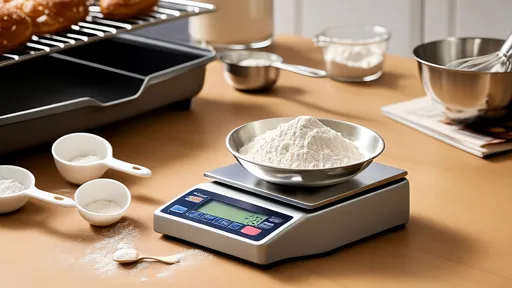
This is where the kitchen scale emerges as the undisputed hero of the modern baker. A good digital scale measures in grams or ounces, offering a level of precision that volumetric tools can only dream of. Weight is absolute. 150 grams of flour is always 150 grams of flour, whether it’s scooped, spooned, sifted, or dumped from the sky. It is immune to the baker’s mood, the weather, and the brand of ingredient. This shift from volume to weight transforms baking from a frustrating guessing game into a repeatable, predictable science.
The benefits are immediate and profound. Consistency is the first and greatest reward. When you bake by weight, you can replicate your successes perfectly every single time. That perfect loaf of sourdough, those chewy-on-the-inside, crispy-on-the-outside chocolate chip cookies—they are no longer happy accidents but guaranteed outcomes. This reliability is the foundation upon which professional bakers build their livelihoods, and it is now accessible to anyone with a $20 scale.
Furthermore, baking by weight is often cleaner and faster. The dreaded pile of dirty measuring cups—one for flour, one for sugar, one for another type of sugar—becomes a thing of the past. With a scale, you can use the beloved "tare" function. Place your mixing bowl on the scale and zero it out. Add your flour until you hit the target weight. Zero it out again. Add your sugar. Zero it out. Add your cocoa powder. All the ingredients are deposited directly into the final bowl, creating barely any mess and significantly streamlining the process. It is efficiency and elegance combined.
Perhaps most importantly, weighing ingredients allows a baker to truly understand a recipe’s formula. Professional recipes are almost always written in ratios, known as baker's percentages. The total flour weight is always treated as 100%, and every other ingredient is expressed as a percentage of that flour weight. This universal language allows bakers to scale recipes up or down with mathematical certainty and to understand the fundamental nature of a dough or batter at a glance. Is it a lean dough? A rich, buttery cake? The percentages tell the story. Volume measurements create a barrier to this deeper understanding; weight measurements demolish it.
For the home baker looking to cross over into this new world of precision, the path is simple. Invest in a digital scale that measures in at least one-gram increments. Begin by seeking out recipes that provide measurements in grams (a rapidly growing trend, thankfully). When encountering a volume-only recipe, use a reliable conversion chart to translate cups into grams, remembering that these are averages and a slight adjustment on the fly might be needed based on the dough’s consistency. Most importantly, trust the scale. It may feel foreign at first, like reading a new language, but fluency comes quickly. The reward is in the results: baked goods that are consistently excellent, a kitchen that is consistently cleaner, and a confidence that is unshakable.
The argument for the kitchen scale, then, is not an argument against tradition. It is not a cold, robotic dismissal of our grandmothers’ wisdom. It is, rather, an evolution of it. Our grandmothers used the best tools they had available to them to create food with love and care. The scale is simply a better tool, a more refined instrument that allows us to honor their intention—to create something delicious and wonderful—with a greater chance of success every time we turn on the oven. In the end, precision is not the enemy of love in the kitchen; it is its most reliable ally.
By /Aug 29, 2025

By /Aug 29, 2025
By /Aug 29, 2025
By /Aug 29, 2025

By /Aug 29, 2025
By /Aug 29, 2025
By /Aug 29, 2025
By /Aug 29, 2025

By /Aug 29, 2025
By /Aug 29, 2025
By /Aug 29, 2025
By /Aug 29, 2025
By /Aug 29, 2025
By /Aug 29, 2025
By /Aug 29, 2025
By /Aug 29, 2025
By /Aug 29, 2025
By /Aug 29, 2025
By /Aug 29, 2025
By /Aug 29, 2025